
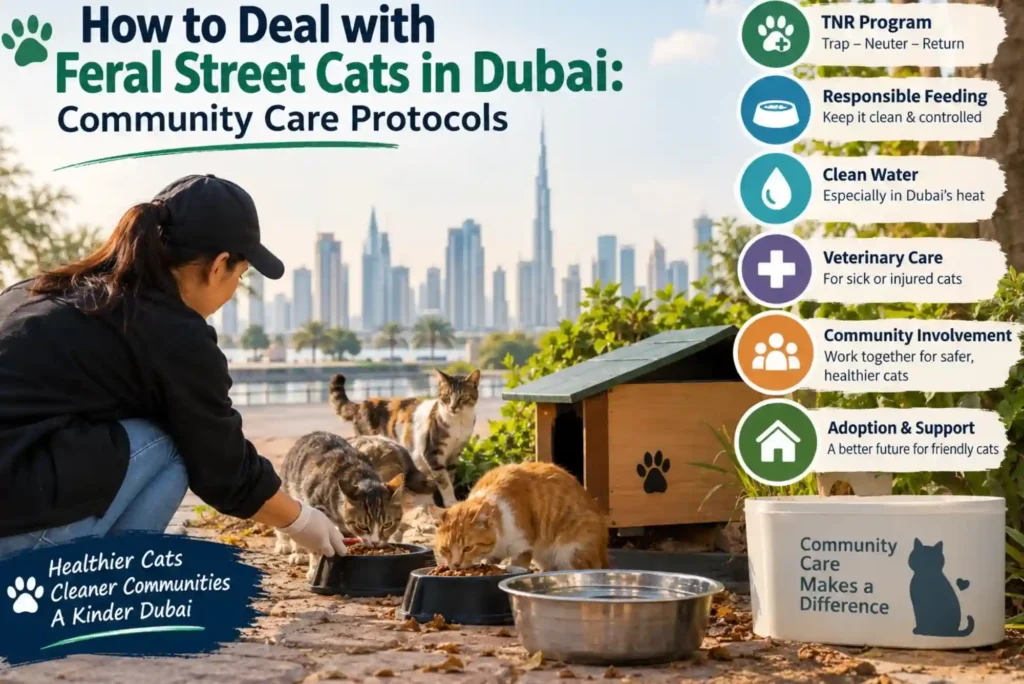
How to Deal with Feral Street Cats in Dubai: Community Care Protocols
Introduction
Feral and free-roaming cats are a familiar part of many residential communities in Dubai. They can be seen around apartment buildings, villas, parking areas, gardens, construction zones, commercial districts, and quieter streets. While some residents enjoy caring for these cats, others may be concerned about noise, hygiene, breeding, injuries, or the presence of cats around shared spaces. Managing a community cat population therefore requires a balanced approach that protects animal welfare while also considering public health, cleanliness, and the needs of local residents.
The most effective approach is not simply to remove cats from an area. Feral cats are often strongly attached to their established territories, and moving them without a suitable plan can create additional welfare problems. Instead, responsible community care focuses on humane population management, appropriate veterinary attention, controlled feeding, monitoring, and cooperation with relevant authorities and animal welfare professionals.
Dubai Municipality has described its approach to stray and loose companion animals as scientific and humane. Its current programs include Trap-Neuter-Return, commonly called TNR, and in some circumstances Trap-Neuter-Vaccinate-Return, or TNVR. Under these approaches, cats may be humanely trapped, sterilized and vaccinated where appropriate, then returned to their original locations when doing so does not create a risk to public safety or the animal’s welfare.
For residents searching for practical information about How to Deal with Feral Street Cats in Dubai: Community Care Protocols, understanding this approach is important. Community care is not about creating an uncontrolled feeding area or attempting to handle every cat personally. It is about creating a safe and sustainable system in which cats are monitored, veterinary needs are addressed, reproduction is controlled, and feeding is managed responsibly.
Understanding Feral Cats in Dubai
A feral cat is generally a domestic cat that lives outdoors and has limited or no regular human socialization. Some feral cats avoid people completely, while others may gradually become comfortable around familiar caregivers. Dubai’s outdoor cat population can also include abandoned pets, lost cats, semi-socialized cats, and cats that have lived around people for generations.
This distinction matters because not every outdoor cat should be treated in exactly the same way. A frightened but previously owned cat may require a different response from a truly unsocialized community cat. Similarly, a young kitten found alone may need assessment before anyone assumes that it has been abandoned.


Community caregivers should therefore observe cats from a safe distance before attempting to intervene. Their appearance, behavior, location, approximate age, and interaction with people can help determine what type of assistance may be appropriate.
The objective should be to reduce suffering and prevent uncontrolled population growth rather than to disturb healthy animals unnecessarily. A stable community-cat program can make it easier to identify sick or injured animals while also reducing repeated breeding.
Why TNR Is Important for Dubai’s Community Cats
One of the most important concepts in modern community-cat management is TNR. The process involves humanely trapping an outdoor cat, arranging sterilization through an appropriate veterinary or animal-welfare service, and returning the cat to its established territory when conditions allow.
Sterilization prevents future litters and can gradually reduce population growth. It also means that caregivers do not have to repeatedly deal with kittens born outdoors under difficult conditions. Over time, a properly managed TNR program can create a more stable population.
Dubai Municipality officially states that it applies TNR and, where appropriate, TNVR as part of its approach to stray and free-roaming companion animals. The Municipality says cats can be trapped, sterilized and vaccinated where required before being returned to their original locations when there is no unacceptable risk to public safety or animal welfare.
This makes sterilization an important part of responsible community care in Dubai. However, individual residents should not assume that they should capture cats themselves without professional guidance. Cats can become frightened during handling, and an unsuitable trapping or transport process can cause injury or significant stress.
Building a Responsible Community Cat Care Program
A successful community-cat program usually begins with observation. Residents can identify where cats regularly gather, whether there are kittens, whether particular animals appear injured, and whether the same cats are being seen consistently.
This information can help establish a basic picture of the local population. Instead of several residents independently feeding the same cats at different times, communities can communicate with one another and develop a more organized approach.
Responsible feeding should be controlled rather than random. Food should not be scattered throughout streets, building entrances, parking spaces, or landscaped areas. Unmanaged food can attract insects and other animals and may create conflict with residents or property management.
Dubai Municipality introduced its “Ihsan” smart feeding-station initiative in 2026, describing the stations as a way of supporting animal welfare while reducing random feeding and improving the management of free-roaming animal populations. The initial initiative included 12 smart feeding units in selected locations.
This demonstrates an important principle: feeding should form part of an organized community-care strategy rather than becoming an uncontrolled activity.
Feeding Feral Cats Safely
Food is often the first thing people think about when they want to help street cats. However, simply putting food outside every day is not always the best solution.
A better approach is to maintain a consistent and hygienic feeding routine in an appropriate location where permitted. Food should be suitable for cats and provided in quantities that can reasonably be consumed. Leftover food should not be allowed to remain in the area for long periods.
Fresh water is also important, particularly in Dubai’s hot climate. Outdoor cats can face significant environmental stress during periods of extreme heat, so access to clean drinking water can be an important part of responsible care.
Feeding areas should be kept clean. Containers should be washed regularly, and spoiled food should be removed. The aim is to support the cats without creating sanitation problems for residents or neighboring properties.
Where a building, residential community, park, or private property has specific rules concerning feeding animals, those requirements should also be respected. Community care works better when residents communicate with property management and avoid creating unnecessary disputes.
Providing Water During Dubai’s Hot Weather
Dubai’s climate creates special challenges for outdoor animals. Cats living outside may seek shade beneath vehicles, landscaping, buildings, or other structures. During very hot weather, water becomes especially important.
Water containers should be placed somewhere stable and reasonably protected from contamination. They should also be checked frequently because outdoor conditions can cause water to become dirty or excessively warm.
Shade can also make a difference. However, residents should avoid creating structures that block walkways, interfere with vehicle access, or violate property rules. A simple sheltered area in an appropriate location can sometimes provide a safer resting place for community cats.
Cats that appear severely distressed by heat, weak, unable to move normally, or otherwise unwell should not simply be given food and left alone. Veterinary assessment may be necessary.
Recognizing When a Feral Cat Needs Veterinary Help
One of the most important responsibilities of a community caregiver is recognizing when an animal needs professional assistance.
A healthy outdoor cat may be cautious around people, but a sudden change in behavior can indicate illness or injury. Visible wounds, difficulty walking, unusual weakness, breathing problems, severe eye problems, persistent vomiting, or an inability to eat or drink can all justify professional evaluation.
Kittens require particular attention. Very young kittens may appear abandoned when their mother is actually nearby. Removing them immediately can separate them from a healthy mother. Observation from a safe distance can sometimes provide important information before intervention.
At the same time, kittens that are cold, injured, extremely weak, or clearly in danger may need urgent assistance.
Dubai Municipality’s Veterinary Services Section is responsible for animal health and welfare and provides preventive and curative veterinary services. The Municipality also states that it monitors veterinary establishments and maintains requirements relating to pet shelters and stray-animal control.
Residents should use qualified veterinary professionals for diagnosis and treatment instead of attempting to administer medication themselves.
Handling Injured or Frightened Cats
Feral cats can react differently from household pets. A frightened cat may scratch or bite when it feels trapped, even when the person is trying to help. This is one reason professional assistance is preferable when an animal requires capture or medical treatment.
Do not chase a frightened cat through traffic or attempt to grab it suddenly. A stressed animal can run into roads or dangerous areas, increasing the risk to both the cat and the people nearby.
When a cat requires veterinary attention, the safest approach is to coordinate with an appropriate animal-welfare or veterinary service that has experience handling community cats.
This is particularly important when several cats are being managed as part of a TNR program. Humane trapping requires planning so that animals are not left unnecessarily exposed to heat, traffic, or prolonged stress.
Managing Cat Populations Through Sterilization
Uncontrolled reproduction is one of the biggest reasons community-cat populations can continue growing. A single unsterilized female can contribute to repeated generations of kittens, especially when food and shelter are readily available.
Sterilization changes that pattern. When cats are consistently sterilized, the number of new kittens entering the outdoor population can gradually decline.
The purpose of TNR is therefore broader than treating individual cats. It is a population-management strategy. Dubai Municipality’s public information specifically identifies surgical population control and TNR/TNVR as part of its approach to free-roaming animals.
For residents interested in helping cats through adoption rather than outdoor care, Ranker.ae also provides information related to pet adoption in the UAE: Pet Adoption in the UAE
When Adoption Is Appropriate
Not every feral cat needs to be removed from its outdoor territory. Some cats are strongly adapted to outdoor life and may experience considerable stress if placed into an unfamiliar indoor environment.
However, adoption can be appropriate for socialized cats, abandoned pets, kittens, or animals that can adapt safely to household life. An injured cat that requires long-term treatment may also need a foster or permanent home if returning outdoors would be unsafe.
Dubai Municipality opened an integrated pet shelter in Warsan in July 2026 and launched a digital adoption platform that allows people to view animals available for adoption along with health and behavioral information. The Municipality says the shelter supports responsible adoption and humane management of stray and loose companion animals.
This creates another pathway for residents who discover a friendly abandoned cat and believe that permanent rehoming may be more appropriate than continued outdoor living.
Community Cats and Residential Buildings
Apartment communities can face unique challenges when cats gather around entrances, parking areas, garbage rooms, or shared gardens. Residents may have different opinions about feeding and animal welfare, so communication is essential.
A community caregiver should avoid placing food directly beside building doors, elevators, children’s play areas, vehicle entrances, or other high-traffic locations. A cleaner and more controlled arrangement can reduce complaints and minimize contact between food, waste, and heavily used public spaces.
Building management can also help identify suitable areas for community-cat care where permitted. Clear communication between residents, security teams, cleaners, property managers, and animal-care volunteers can prevent misunderstandings.
The goal should not be to create conflict between people who want to help animals and people who are concerned about cleanliness. A managed system can address both concerns.
Hygiene and Environmental Responsibility
Good hygiene is a central part of community cat care. Food waste, disposable containers, scattered leftovers, and unclean feeding areas can attract pests and create unpleasant conditions.
Caregivers should keep feeding areas tidy and remove waste responsibly. Water containers should be cleaned frequently, and food should not be left exposed unnecessarily.
Cats should also not be encouraged to gather in locations where their presence could create a traffic hazard. Dubai Municipality’s public-utility information specifically identifies stray-animal control as a measure intended to reduce risks associated with animals on roads and in residential areas while supporting public health and population control.
Responsible care therefore means considering the wider environment rather than focusing only on feeding individual animals.
Working With Dubai Municipality
Residents who encounter stray or free-roaming animals should understand that Dubai Municipality has formal animal-welfare and stray-animal services. The Municipality’s current services include stray-animal management, veterinary services, and pet adoption facilities.
For current official information, residents can use the Municipality’s website or its service channels rather than relying solely on social-media advice. Dubai Municipality’s contact information states that its 800900 contact center is available around the clock for inquiries and notifications.
The official Dubai Municipality website is therefore an important reference when a community caregiver needs to determine which service is appropriate or wants to report an animal-related concern: Dubai Municipality
Using official channels is particularly useful when a cat is injured, located in a dangerous area, creating a public-safety concern, or appears to be an abandoned owned pet.
Why Removing Every Cat Is Not a Complete Solution
It can be tempting to believe that removing all visible cats from a location will permanently solve the problem. In reality, community-cat populations can be more complicated.
If food and shelter remain available, other cats may move into the same territory. Removing cats without addressing reproduction and environmental conditions may therefore fail to provide a sustainable solution.
A population-management approach focuses on sterilization, responsible feeding, health monitoring, and appropriate intervention. The aim is to create a stable situation in which cats are healthier and reproduction is controlled.
This is consistent with Dubai Municipality’s stated approach, which combines humane care, population management, TNR/TNVR, sheltering, veterinary treatment, and responsible adoption.
Caring for Kittens in Outdoor Colonies
Kittens are often the most vulnerable members of a community-cat population. Their survival can depend on their mother, access to food, shelter, and protection from environmental hazards.
Before taking a kitten away, residents should determine whether its mother is nearby. A mother cat may leave temporarily to search for food and return later.
If a kitten appears healthy and the location is reasonably safe, observation may be more appropriate than immediate removal. If the kitten is injured, seriously weak, trapped, or exposed to immediate danger, professional assistance should be considered.
As kittens grow, socialization can also affect whether they may eventually be suitable for adoption. Young cats that become comfortable around people can sometimes transition more easily into homes than mature feral cats.
Creating a Long-Term Community Care Strategy
A successful community-cat program needs continuity. Feeding one group of cats for a few weeks without monitoring sterilization, health, and environmental conditions may not address the underlying problem.
Long-term care is more effective when residents know which cats have already been sterilized, which animals need veterinary attention, and which cats may be candidates for adoption.
Where several residents participate, communication can prevent duplicated feeding and help ensure that sick or injured animals are identified quickly.
The program should also remain flexible. Construction projects, changes in property management, road works, extreme weather, and changes in the local cat population can all affect where animals can safely remain.
The central principle is simple: community care should improve the welfare of the cats while reducing avoidable problems for people and the surrounding environment.
Responsible Pet Ownership Can Reduce Future Stray Populations
Community-cat management is only one part of reducing the number of animals living outdoors. Responsible ownership is equally important.
Pet cats should not be abandoned when owners move, face financial difficulties, or can no longer care for them. Where possible, owners should seek legitimate rehoming, veterinary, foster, or adoption support rather than releasing a household cat outdoors.
Dubai Municipality has emphasized responsible pet ownership alongside adoption and animal welfare. Its 2026 shelter initiative specifically aims to provide safer outcomes for stray and loose companion animals while connecting suitable animals with adoptive families.
People interested in broader pet-care information can also explore the main Ranker.ae resource: Ranker.ae
Conclusion
Dealing with feral street cats in Dubai requires more than simply feeding animals or trying to remove them from a neighborhood. A responsible approach combines humane treatment, population management, veterinary care, appropriate feeding, clean water, careful monitoring, and cooperation with relevant authorities.
TNR and TNVR are particularly important because they address reproduction while allowing suitable community cats to remain in familiar territories when returning them is safe. Dubai Municipality has publicly identified these methods as part of its humane approach to managing stray and free-roaming companion animals.
For individual residents, the most useful role is often to observe, report genuine welfare concerns, maintain hygienic care practices, support sterilization through appropriate channels, and consider adoption when a socialized or abandoned cat is suitable for a home.
Dubai’s approach to community animals continues to develop, including expanded shelter facilities, digital adoption services, veterinary support, and organized feeding initiatives. These developments show why community cat care is best approached as a coordinated animal-welfare issue rather than an informal feeding activity.
When residents, property communities, veterinary professionals, animal-welfare organizations, and municipal services work within appropriate roles, feral and free-roaming cats can be managed more humanely while reducing unnecessary conflict and improving the overall welfare of animals and people in Dubai.
