
1. What Is Debt Collection in Dubai?
Debt collection Dubai is the process of recovering money owed by individuals, businesses, or other entities under a contractual or legal obligation. Debts may arise from unpaid invoices, personal loans, commercial agreements, bounced payments, rental obligations, or other financial arrangements. When a debtor fails to pay within the agreed period, the creditor may consider negotiation, a formal payment demand, mediation, or legal proceedings.
Debt collection Dubai services help creditors understand their available options and take appropriate steps to recover outstanding amounts. Depending on the circumstances, this may involve reviewing contracts, examining invoices, gathering payment records, issuing legal notices, filing court claims, or pursuing enforcement after obtaining an enforceable judgment.
The appropriate approach depends on the nature of the debt, the evidence available, the applicable law, and whether the parties fall under the Dubai Courts, the DIFC Courts, or another competent jurisdiction.
2. When Should a Creditor Seek Debt Collection Assistance in Dubai?
Creditors should consider seeking professional assistance when repeated payment reminders have failed, an invoice remains unpaid beyond its due date, a debtor disputes an obligation, or a substantial amount has remained outstanding for an extended period.
Early action can help prevent unnecessary delays and preserve important evidence. For example, a business dealing with an overdue commercial invoice should maintain the signed contract, purchase orders, delivery confirmations, invoices, account statements, and correspondence relating to the outstanding balance.
A debt collection professional or lawyer can review these documents, assess potential weaknesses in the claim, and recommend a proportionate recovery strategy. Seeking advice early may also help identify limitation periods or contractual requirements that could affect the creditor’s rights.


3. What Types of Debts Can Be Recovered in Dubai?
Debt recovery in Dubai may involve several categories of financial obligations, provided there is a valid legal basis for the claim.
Common examples include:
- Commercial debts: Unpaid invoices, outstanding supplier payments, and overdue business accounts.
- Personal loans: Money borrowed under documented repayment arrangements.
- Business loans: Outstanding amounts owed under financing agreements.
- Rental-related debts: Certain unpaid rent or contractual charges, subject to the applicable rules and forum.
- Construction debts: Unpaid contractor invoices, subcontractor payments, and other sums due under construction contracts.
- Service fees: Outstanding payments for professional, consulting, maintenance, or other services.
- Trade debts: Amounts due from importers, exporters, distributors, or commercial customers.
Each claim requires an individual assessment. The existence of an unpaid amount does not automatically guarantee recovery, particularly where the debtor disputes the agreement, the goods or services supplied, or the calculation of the balance.
4. What Documents Are Required for Debt Collection Dubai Proceedings?
Supporting documentation is essential when attempting to recover a debt. The specific requirements depend on the transaction, the type of claim, and the legal procedure being considered.
Creditors should generally gather the following records:
- Contracts and agreements: Documents establishing the parties’ obligations, payment terms, and applicable dispute-resolution provisions.
- Invoices and statements: Records identifying the outstanding amounts and relevant due dates.
- Delivery or completion evidence: Documents confirming that goods were delivered or services were performed, where relevant.
- Payment records: Bank statements, receipts, transaction confirmations, and records of partial payments.
- Correspondence: Emails, letters, and messages in which the parties discuss the debt or acknowledge an obligation.
- Debtor information: Accurate legal names and available registration or identification details needed to identify the correct party.
- Demand notices: Copies of formal payment requests and evidence of their delivery, where available.
Documents originating in another country may require translation, authentication, or other formalities depending on the intended use. A lawyer can help determine which records are necessary and whether additional evidence is required.
5. Can a Creditor Recover a Debt Without Going to Court?
Yes. Many debts can be resolved through direct negotiation or other appropriate settlement methods without commencing court proceedings.
A creditor may begin by sending a written payment reminder explaining the amount outstanding, the original payment deadline, and a reasonable date for settlement. If the debtor does not respond, a more formal demand may be appropriate.
Negotiations may result in full payment, a structured instalment arrangement, or another mutually acceptable settlement. Any repayment agreement should clearly identify the debt, payment dates, consequences of default, and other relevant terms.
Mediation or another agreed dispute-resolution method may also be suitable. However, creditors should consider the debtor’s financial position, the strength of their evidence, and the likelihood of voluntary payment before investing significant time in negotiations.
A settlement should be documented carefully. Where necessary, legal advice can help ensure that the agreement is enforceable and does not unintentionally compromise rights relating to the remaining balance.
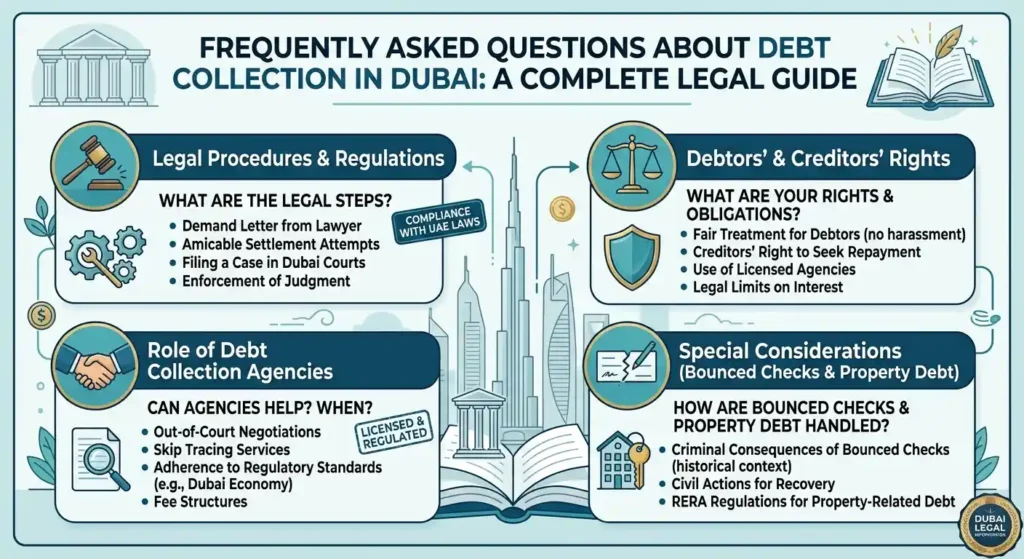
6. How Does the Legal Debt Collection Process Work in Dubai?
The process varies according to the claim, the available evidence, and the competent court or dispute-resolution forum. A typical recovery process may involve the following stages.
Step 1: Review the debt. The creditor gathers relevant records and determines the outstanding amount, contractual terms, and identity of the debtor.
Step 2: Send a payment demand. A written notice may request payment by a specified date. Any contractual or statutory notice requirements should be considered.
Step 3: Attempt settlement. The parties may negotiate a payment plan, settlement, or another resolution.
Step 4: Determine the appropriate legal route. If the debtor refuses to pay, the creditor may need to initiate proceedings before the competent court or use another available procedure. Certain claims supported by qualifying documents may be eligible for a payment-order procedure, subject to applicable legal requirements.
Step 5: Obtain a decision or enforceable instrument. If the claim succeeds, the creditor may obtain a judgment, order, or other instrument capable of enforcement.
Step 6: Pursue enforcement where necessary. If payment remains outstanding, the creditor may seek lawful enforcement measures available under the applicable rules.
Not every case follows all these stages, and filing requirements, deadlines, court fees, and procedural options should be verified before proceeding.
7. How Long Does Debt Collection Take in Dubai?
There is no single timeline for every debt collection case. Straightforward debts may be settled quickly if the debtor accepts liability and has the resources to pay. Contested claims can take substantially longer because of procedural requirements, evidence disputes, expert assessments, appeals, or enforcement difficulties.
The time required may depend on the amount claimed, the quality of the documentation, the debtor’s response, the applicable jurisdiction, and whether assets are available for lawful enforcement.
Creditors should be cautious about guaranteed recovery dates. A lawyer can provide a more realistic assessment after reviewing the circumstances, although the outcome and timing cannot be assured.
8. What Happens If a Debtor Refuses to Pay?
If a debtor refuses to pay despite receiving a valid demand, the creditor may consider formal legal proceedings. The appropriate route depends on the legal basis of the debt and the available supporting evidence.
Where a creditor obtains an enforceable judgment or order, enforcement measures may be available under the relevant legal framework. Depending on the case, these may include measures involving eligible assets or funds, subject to legal safeguards and the applicable procedures.
However, creditors cannot simply seize property, threaten debtors, disclose confidential financial information publicly, or use unlawful pressure to force payment. Any recovery action must comply with applicable UAE laws and procedural requirements.
A debtor’s failure to respond to a demand does not automatically establish every element of the claim. Creditors should ensure that their evidence supports the amount claimed and that the proper legal process is followed.
9. Can a Foreign Company Recover Unpaid Debts in Dubai?
Foreign businesses may be able to recover debts owed by customers or commercial partners in Dubai. The available options depend on the agreement, the location and legal status of the parties, the dispute-resolution clause, and the jurisdiction with authority to hear the matter.
An overseas company should preserve its original contracts, invoices, shipping records, delivery documents, and correspondence. It should also establish the correct legal identity of the debtor and calculate the balance accurately.
If the agreement provides for arbitration or a particular court, that clause may affect the appropriate route. Foreign judgments and arbitral awards may also require separate recognition or enforcement procedures before they can be enforced in the UAE.
Legal advice can help an overseas creditor understand jurisdictional issues, document requirements, possible costs, and the practical prospects of recovering the debt.
10. How Can Businesses Reduce Future Debt Collection Problems?
Prevention is often more efficient than pursuing overdue payments after a dispute develops. Businesses operating in Dubai can reduce risk by adopting clear credit-control procedures.
Useful practices include:
- Conducting reasonable checks before extending credit to new customers.
- Using written contracts that specify payment terms, due dates, and responsibilities.
- Issuing accurate invoices promptly.
- Recording deliveries, completed work, and customer approvals.
- Monitoring overdue accounts and sending reminders consistently.
- Keeping complete records of communications and payments.
- Reviewing credit limits and payment arrangements for higher-risk customers.
- Obtaining legal advice before agreeing to significant changes in payment terms.
Businesses should also ensure that their collection practices comply with applicable laws and respect confidentiality. A structured internal process can help identify payment problems early and make any later legal claim easier to document.
11. What Should You Consider Before Choosing a Debt Collection Lawyer in Dubai?
When selecting a lawyer or legal service provider, consider their experience with the relevant type of debt, familiarity with the appropriate court or dispute-resolution forum, and ability to explain the proposed recovery strategy clearly.
Ask about the documents required, expected procedural stages, professional fees, court expenses, possible enforcement costs, and the risks of pursuing the claim. It is also important to understand whether the provider will handle negotiations, formal notices, court proceedings, and enforcement or only selected parts of the process.
No professional can legitimately guarantee that every debt will be recovered. The debtor may lack sufficient assets, dispute the claim successfully, or raise legal defences that affect the outcome. A realistic assessment should address these risks before substantial costs are incurred.
Conclusion
Debt collection Dubai procedures provide creditors with several possible routes for addressing unpaid financial obligations, ranging from written payment demands and negotiated settlements to court proceedings and lawful enforcement. The best approach depends on the debt’s legal basis, the quality of the evidence, the debtor’s circumstances, and the applicable jurisdiction.
Maintaining accurate records, acting promptly, and obtaining appropriate legal guidance can help creditors make informed decisions and avoid procedural mistakes. Businesses and individuals should assess the costs, risks, and likely benefits of recovery before deciding how to proceed.
Disclaimer: This article provides general information about debt collection in Dubai and is not legal advice. Applicable laws, procedures, deadlines, and outcomes depend on the facts of each case and should be confirmed with a qualified legal professional.
