
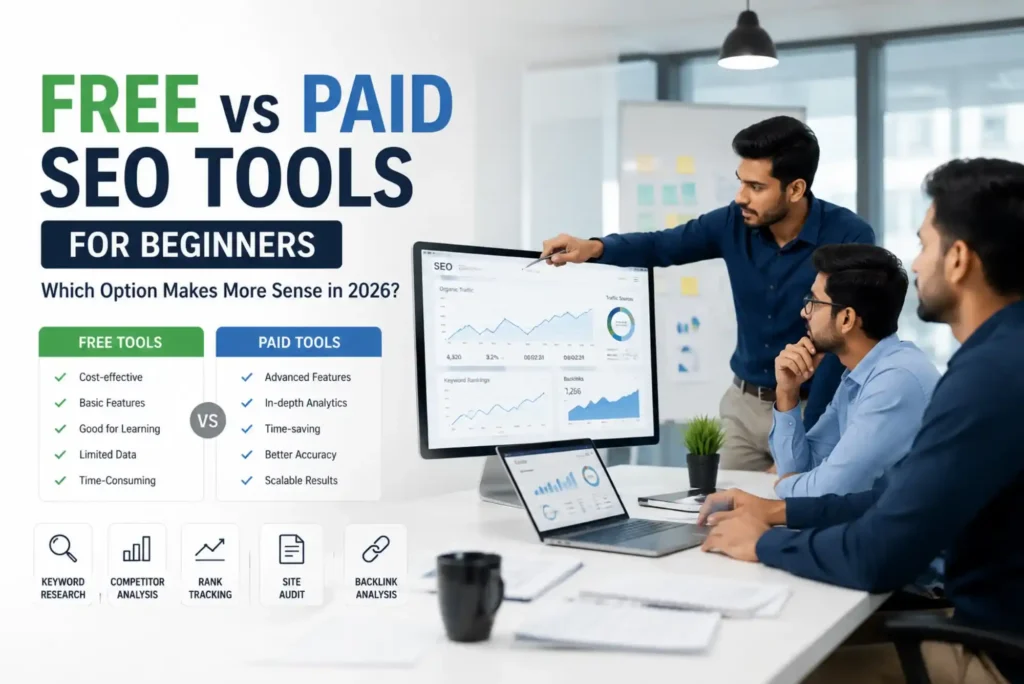
In 2026, learning SEO no longer requires a massive budget, a full marketing team, or enterprise-level software. A laptop, internet connection, and access to the right tools can be enough to build meaningful search visibility. Yet for beginners entering the SEO space today, one question appears almost immediately: should you rely on free SEO tools or invest in paid platforms from the beginning?
The answer is more nuanced than most comparison articles suggest. Free tools have become dramatically more capable over the last few years, especially with AI-assisted search analysis and automation becoming mainstream. At the same time, paid platforms continue to dominate when it comes to scalability, competitive intelligence, workflow efficiency, and deeper analytics.
For freelancers, small businesses, startup founders, bloggers, and first-time marketers, choosing the right path can directly impact learning speed, marketing ROI, and long-term growth. Understanding where free tools excel — and where paid tools justify their cost — matters more than ever.
The SEO Landscape Has Changed Significantly Since 2020
SEO in 2026 looks very different from the keyword-stuffing era many beginners still imagine. Search engines now evaluate topical authority, user experience, content quality, page speed, engagement metrics, and semantic relevance with far greater sophistication.
That shift has increased demand for better optimization tools. Modern SEO professionals rely on software not just for keyword tracking, but for technical audits, competitor analysis, content planning, SERP monitoring, schema implementation, and AI-driven optimization recommendations.
Interestingly, many free platforms now offer features that were once available only in premium suites. Google itself continues to provide foundational tools like Google Search Console and Google Analytics, which remain essential for any SEO strategy.


Meanwhile, educational resources around optimization have also expanded. Websites covering topics like SEO analytics and performance tracking have made technical SEO more accessible for newer marketers who previously struggled with implementation.
What Free SEO Tools Actually Do Well
Free SEO tools are no longer “limited demos.” Many now provide genuinely useful functionality that can support real organic growth, especially for beginners managing smaller websites.
The biggest advantage is obvious: accessibility. New website owners can experiment with keyword research, technical audits, indexing diagnostics, and content optimization without financial pressure.
Several free platforms also encourage better learning habits. Because limitations exist, beginners often develop a stronger understanding of SEO fundamentals instead of relying entirely on automation. They learn how search engines crawl pages, how metadata affects visibility, and why site structure matters.
Free tools are particularly effective for:
- Learning SEO basics
- Monitoring small websites
- Checking keyword rankings occasionally
- Running basic technical audits
- Analyzing page performance
- Understanding indexing and crawl issues
For example, website speed optimization has become increasingly important as Core Web Vitals continue influencing rankings. Even free optimization platforms can provide meaningful improvements when paired with educational guides such as image compression and website speed optimization strategies.
For bloggers, local businesses, or affiliate marketers operating with limited traffic, free tools may be more than sufficient during the early stages.
Where Free SEO Tools Begin to Struggle
The limitations become clear once a website starts scaling.
Most free tools restrict data access, historical reporting, keyword tracking volume, export functionality, or competitor visibility. While these restrictions may seem minor initially, they create operational bottlenecks over time.
A beginner managing a five-page website may not notice these constraints. But a growing business targeting multiple keyword clusters across competitive markets quickly encounters friction.
One major issue is fragmented workflows. Free SEO often means switching between numerous disconnected platforms for analytics, keyword research, backlink monitoring, technical audits, and content optimization. This increases inefficiency and can lead to inconsistent decision-making.
Another challenge is accuracy. Many free keyword tools provide broad estimates rather than actionable search intelligence. Competitive analysis may also lack depth, making it difficult to identify realistic ranking opportunities.
As SEO becomes more data-driven, incomplete information can sometimes be more dangerous than no information at all.
Why Paid SEO Tools Continue to Dominate Professional Marketing
Paid SEO platforms remain industry standards for a reason. They centralize workflows, automate repetitive analysis, and provide deeper competitive insights that free tools typically cannot match.
In 2026, modern SEO platforms are increasingly powered by AI-driven forecasting and predictive analytics. Instead of simply reporting rankings, premium tools now identify content gaps, estimate ranking difficulty more accurately, and recommend optimization strategies based on live SERP behavior.
For beginners serious about building long-term authority, these features can significantly shorten the learning curve.
Paid tools excel in several areas:
- Comprehensive keyword databases
- Advanced backlink analysis
- Competitor monitoring
- Technical SEO automation
- Content optimization recommendations
- Large-scale rank tracking
- Workflow integrations
More importantly, paid platforms save time. SEO today involves ongoing monitoring, content adjustments, and performance analysis. Automation becomes increasingly valuable as projects expand.
Businesses investing in scalable organic growth strategies often combine premium SEO software with specialized services such as professional SEO campaigns to improve efficiency and long-term visibility.
The Real Question Isn’t “Free or Paid”
Many beginners approach this decision incorrectly. They assume free and paid tools compete directly with one another. In reality, they often serve different stages of growth.
Free tools are excellent for learning and validation.
Paid tools are designed for scaling and competitive execution.
A beginner launching a niche blog in 2026 probably does not need an expensive enterprise subscription immediately. But once organic traffic becomes tied to revenue generation, investing in stronger analytics and automation becomes easier to justify.
The smartest approach is usually transitional rather than absolute.
Many successful marketers begin with free tools, learn SEO fundamentals thoroughly, and later adopt premium software strategically when limitations begin affecting results.
How AI Is Changing the SEO Tool Conversation
Artificial intelligence has dramatically reshaped SEO software over the last two years. In 2026, even entry-level tools now include AI-assisted recommendations, content scoring, SERP intent analysis, and automated technical insights.
This evolution has narrowed the gap between free and paid solutions in certain areas.
For example, AI-powered keyword clustering — once exclusive to expensive enterprise software — is increasingly available in affordable or freemium platforms. Automated content optimization has also become more accessible.
However, premium tools still maintain advantages in training data quality, reporting sophistication, API access, and enterprise integrations.
The AI revolution has not eliminated the need for paid tools. Instead, it has made the distinction more strategic. Beginners must now decide whether they need basic AI assistance or advanced competitive intelligence.
Budget Isn’t the Only Factor Beginners Should Consider
Cost matters, especially for independent creators and startups. But beginners often underestimate another critical resource: time.
Free tools may reduce upfront spending while increasing operational complexity. Paid tools may seem expensive initially but can reduce hours spent switching platforms, compiling reports, or manually analyzing competitors.
This tradeoff becomes particularly important for solo entrepreneurs managing SEO alongside other responsibilities.
A business owner spending six hours weekly gathering fragmented SEO data may actually lose more money in time than they would spend on a streamlined subscription.
That’s why the right decision depends heavily on goals.
If the objective is simply learning SEO basics or growing a small hobby site, free tools remain highly practical. If the goal involves aggressive content scaling, lead generation, or revenue-focused search growth, paid platforms usually deliver stronger long-term value.
What Beginners Should Prioritize First
Before spending money on premium SEO software, beginners should first master the fundamentals that drive rankings regardless of tools.
That includes understanding:
- Search intent
- Content quality
- Technical site health
- Internal linking
- User experience
- Website speed
- Topical relevance
Without these foundations, even the most advanced SEO platform becomes ineffective.
Many successful websites continue generating strong traffic using relatively simple tool stacks because they prioritize content quality and strategic consistency over excessive software dependence.
Tools support strategy. They do not replace it.
The Best Approach for Beginners in 2026
For most newcomers, the ideal strategy is hybrid rather than extreme.
Start with free tools to build foundational SEO knowledge. Use them to understand indexing, keyword intent, on-page optimization, and analytics interpretation. Learn how search visibility actually works before investing heavily.
Once your website gains traction — whether through growing traffic, monetization, or client work — selectively adopt paid tools that solve specific bottlenecks.
That progression creates stronger marketers because it combines technical understanding with operational efficiency.
It also prevents one of the most common beginner mistakes in SEO: paying for advanced software before developing the expertise needed to interpret the data properly.
Conclusion
So, which option makes more sense in 2026: free or paid SEO tools?
For beginners, free SEO tools remain the best starting point for learning the fundamentals and building initial momentum. They are more capable today than ever before and can support meaningful growth for smaller websites.
But as competition intensifies and SEO becomes increasingly data-driven, paid platforms provide advantages that are difficult to ignore. Better automation, deeper insights, competitive intelligence, and workflow efficiency can significantly accelerate growth once scaling becomes a priority.
The smartest decision is rarely choosing one side permanently. It’s understanding when to transition from learning-focused tools to growth-focused platforms.
In 2026, successful SEO beginners are not necessarily the ones spending the most money. They are the ones using the right tools at the right stage of their journey.
FAQs
Are free SEO tools enough for beginners?
Yes, free SEO tools are often sufficient for learning fundamentals, optimizing smaller websites, and understanding search performance during the early stages.
When should beginners switch to paid SEO tools?
Beginners should consider paid tools once website growth, keyword competition, or reporting complexity starts exceeding what free platforms can handle efficiently.
Do paid SEO tools guarantee better rankings?
No. Paid tools improve efficiency and insights, but rankings still depend on content quality, technical SEO, user experience, and strategy execution.
What is the biggest advantage of paid SEO platforms?
The biggest advantage is comprehensive data analysis combined with workflow automation, which helps marketers scale SEO campaigns more effectively.
Can beginners learn SEO without expensive software?
Absolutely. Many successful SEO professionals started using free tools before gradually adopting premium platforms as their projects expanded.
Related Reading: Best All-in-One SEO Tools for Beginners in 2026: What to Use and Why
Related Reading: Affordable SEO Tools for Beginners on a Practical Budget in 2026
