
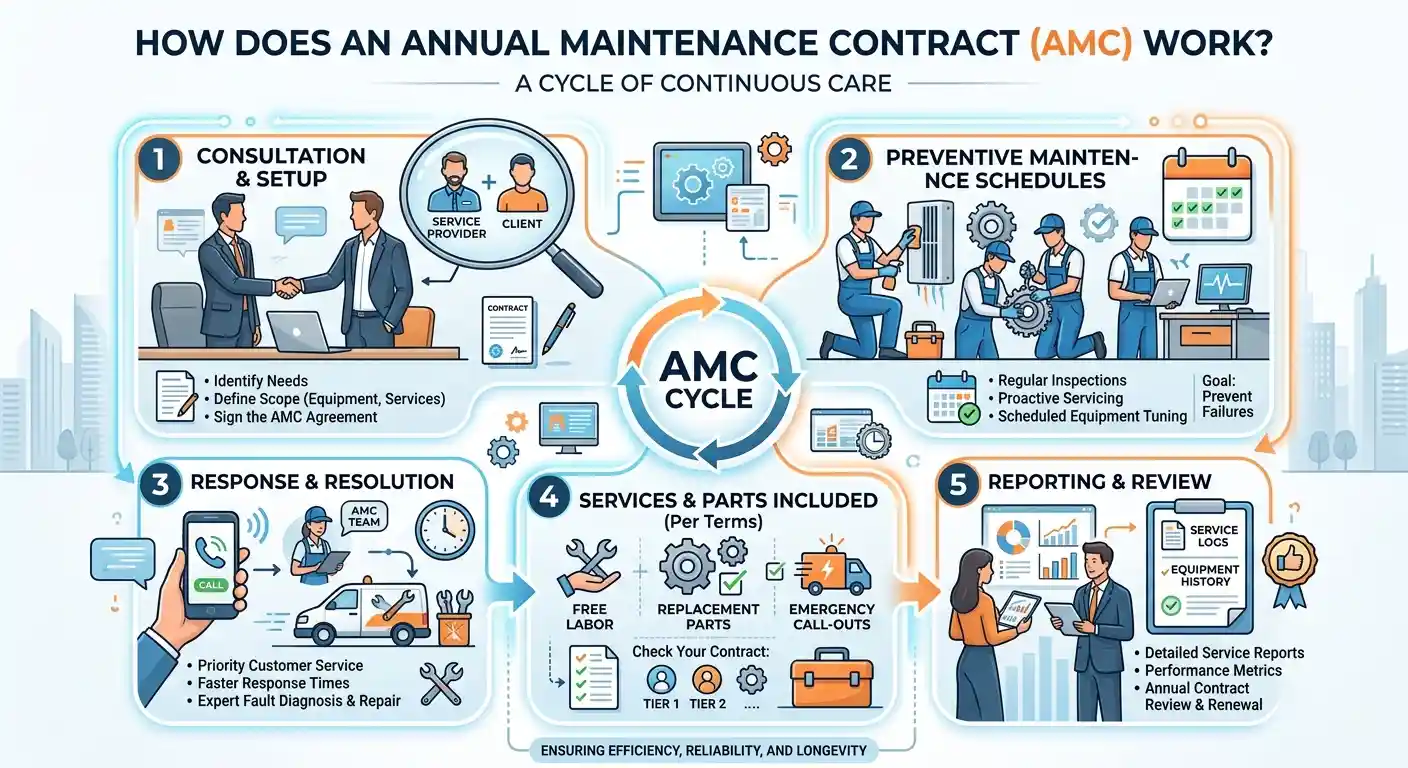
Understanding How an Annual Maintenance Contract Works
Maintaining equipment, facilities, and essential building systems is an important responsibility for every business. Regular maintenance helps prevent unexpected failures, supports efficient operation, and protects valuable assets from premature damage.
An Annual Maintenance Contract (AMC) provides businesses and property owners with a structured way to manage these maintenance requirements. Instead of arranging maintenance services only when something stops working, an AMC establishes an ongoing relationship with a professional maintenance provider.
But how exactly does an annual maintenance contract work? The process generally involves assessing maintenance requirements, selecting a suitable provider, defining the scope of services, scheduling regular inspections, and providing technical support throughout the contract period.
Understanding how the process works can help businesses choose an agreement that meets their operational requirements.
What Is an Annual Maintenance Contract?
An annual maintenance contract is a service agreement between a customer and a maintenance provider for a specific period, usually one year. Under the agreement, the maintenance company provides predefined services for the equipment, systems, or property covered by the contract.
The services can vary depending on the customer’s needs. An AMC may include routine inspections, preventive maintenance, cleaning, servicing, troubleshooting, minor repairs, and technical support.
Some contracts may also include emergency assistance or specific replacement parts. However, major repairs, spare parts, or replacement equipment may be excluded or charged separately.
For this reason, customers should always review the terms and conditions before signing an AMC.
Step 1: Assessing Maintenance Requirements
The first step in establishing an annual maintenance contract is understanding what needs to be maintained.
A maintenance provider may inspect the customer’s property, equipment, or existing systems to determine their condition and maintenance requirements.
For example, a commercial property may require regular maintenance for air conditioning systems, electrical installations, plumbing, generators, fire safety equipment, or other building services.
The provider uses this information to determine the level of service required and develop an appropriate maintenance plan.
Step 2: Selecting a Maintenance Provider
Once the maintenance requirements are understood, the customer can evaluate suitable maintenance companies.
Businesses should not select a provider based only on price. Technical experience, service quality, response time, availability, reputation, and knowledge of the relevant equipment are also important considerations.
A reliable maintenance provider should be capable of handling the systems covered under the agreement and should have qualified technicians who can perform inspections and servicing correctly.
Businesses can compare multiple providers to understand differences in pricing, service coverage, contract terms, and support options.
Step 3: Defining the Scope of Services
After selecting a potential provider, both parties need to establish exactly what the contract will cover.
The scope of services should identify the equipment, systems, or areas included in the AMC. It should also explain the maintenance tasks that will be performed.
For example, the agreement may include scheduled inspections, cleaning, testing, adjustments, lubrication, troubleshooting, and preventive servicing.
Clearly defining the scope helps ensure that the customer understands what is included and prevents confusion about additional services later.
Step 4: Establishing a Maintenance Schedule
A major part of an annual maintenance contract is the maintenance schedule.
Depending on the type of equipment and its usage, maintenance may be performed monthly, quarterly, biannually, or according to manufacturer recommendations.
The maintenance provider creates a schedule based on the customer’s requirements. Technicians then visit the property at the agreed intervals to inspect and service the relevant systems.
Regular scheduling is important because preventive maintenance is most effective when it is performed consistently rather than only when problems occur.
Step 5: Carrying Out Routine Inspections
During scheduled visits, maintenance technicians inspect the equipment or systems covered by the contract.
They may check for unusual sounds, leaks, damaged components, reduced performance, electrical issues, signs of wear, or other potential problems.
The purpose of these inspections is to identify issues at an early stage.
Finding a minor fault during a routine inspection can allow the customer to address it before it develops into a more serious breakdown.
Step 6: Performing Preventive Maintenance
After inspection, technicians may carry out preventive maintenance tasks according to the contract.
These tasks can include cleaning components, replacing filters, tightening connections, lubricating moving parts, checking system performance, making adjustments, and testing equipment.
The exact procedures depend on the type of equipment and the requirements specified in the AMC.
Preventive maintenance can help maintain equipment performance and reduce the risk of unexpected failures.
Step 7: Handling Repairs and Maintenance Issues
An annual maintenance contract may also provide support when a maintenance issue occurs between scheduled visits.
The customer can contact the maintenance provider and report the problem. The provider then evaluates the issue and determines the appropriate response.
If the repair is covered under the agreement, the technician may resolve the issue according to the contract terms. If the problem involves excluded services or replacement parts, additional charges may apply.
This is why customers should understand the repair and emergency support provisions before signing the contract.
Step 8: Recording Maintenance Activities
Professional maintenance providers often maintain records of inspections and services performed during the contract period.
These records can include the date of each visit, equipment inspected, work completed, problems identified, repairs performed, and recommendations for future maintenance.
Maintenance records can be useful for tracking equipment condition and identifying recurring problems.
They can also help businesses plan future repairs and replacement decisions based on actual maintenance history.
Step 9: Monitoring Equipment Performance
An AMC is not simply about performing scheduled visits. Effective maintenance also involves monitoring how equipment performs over time.
If technicians notice declining performance or repeated faults, they can inform the customer and recommend appropriate action.
For example, an aging system may require more frequent repairs than newer equipment. Maintenance records can help identify these trends and allow businesses to make informed decisions.
Step 10: Reviewing the Contract Before Renewal
As the annual contract approaches its end, the customer should review the services received during the contract period.
Businesses can evaluate the provider’s response time, quality of maintenance, number of service visits, recurring problems, and overall value.
If the provider has performed well, the business may renew the agreement. If requirements have changed, the contract can potentially be adjusted to provide more suitable coverage.
A yearly review helps ensure that the maintenance agreement continues to match the customer’s operational needs.
What Does an AMC Usually Cover?
The exact coverage of an annual maintenance contract varies from one provider to another.
Common services may include preventive maintenance, routine inspections, equipment cleaning, testing, troubleshooting, minor repairs, and technical assistance.
Some contracts may provide emergency support or priority service, while others may focus only on scheduled maintenance.
Customers should avoid assuming that every maintenance service is automatically included. The agreement should clearly state the services covered, exclusions, additional charges, and responsibilities of both parties.
What Is Usually Excluded From an AMC?
Many annual maintenance contracts have certain exclusions. These may include major replacement parts, complete equipment replacement, extensive repairs caused by misuse, modifications, or damage resulting from external factors.
The exclusions depend entirely on the provider and contract type.
Before signing an agreement, businesses should ask the provider to explain any services that are not included. Understanding exclusions can help prevent unexpected costs during the contract period.
How Much Does an Annual Maintenance Contract Cost?
There is no single price for an annual maintenance contract because the cost depends on several factors.
The type and number of systems being maintained, property size, equipment condition, maintenance frequency, technical complexity, service coverage, and emergency support can all influence the overall cost.
A basic maintenance agreement may cost less than a comprehensive contract that includes frequent inspections, emergency support, and additional services.
Businesses should compare the total value of each contract rather than choosing the lowest price.
Benefits of Understanding the AMC Process
Understanding how an annual maintenance contract works allows businesses to make better maintenance decisions.
When customers know what happens during the contract period, they can evaluate service providers more effectively and identify whether an agreement provides appropriate coverage.
It also helps businesses understand their responsibilities, including reporting problems, providing access to equipment, following operating instructions, and maintaining accurate service records.
Clear communication between the customer and maintenance provider is essential for a successful long-term maintenance relationship.
Final Thoughts
An Annual Maintenance Contract works by establishing a structured maintenance relationship between a customer and a professional service provider. From the initial assessment and contract preparation to scheduled inspections, preventive servicing, repairs, documentation, and renewal, each stage contributes to effective maintenance management.
A well-designed AMC can help businesses reduce unexpected breakdowns, improve equipment reliability, simplify maintenance planning, and protect valuable assets.
Before signing an agreement, businesses should carefully review the scope of services, maintenance schedule, response times, exclusions, additional costs, and renewal terms. Choosing a suitable provider and establishing clear expectations can make an annual maintenance contract a valuable part of long-term facility and equipment management.