
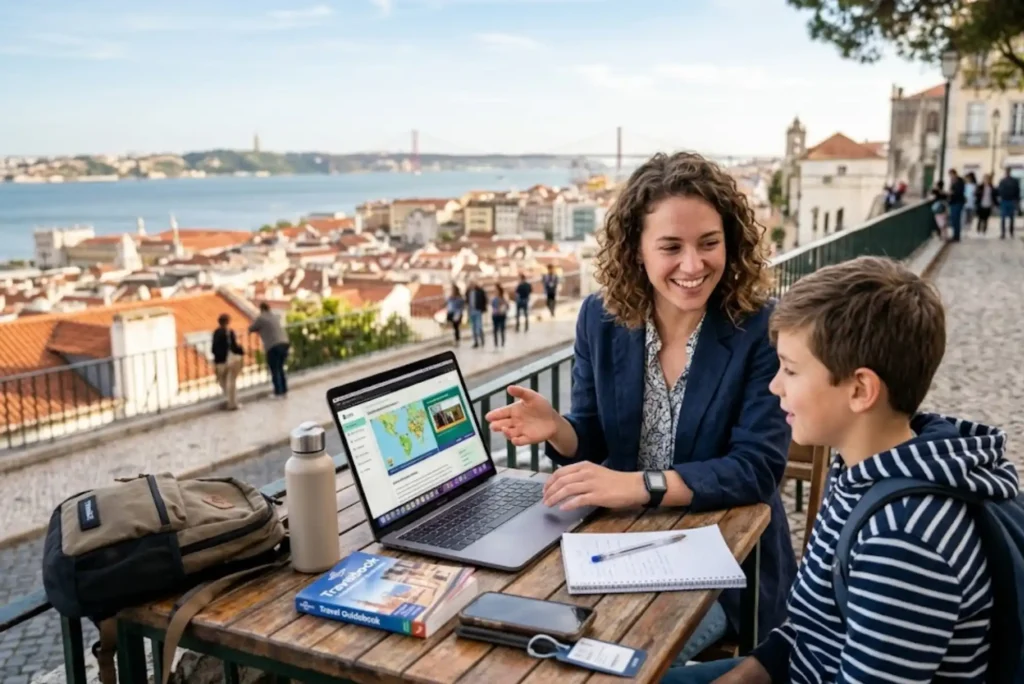
The travel tutor, as a professional role, sits at the intersection of these converging forces: the maturation of remote education technology, the growing acceptance of non-institutional learning models, and a renewed cultural appreciation for the kind of deep, embodied knowledge that only comes from direct engagement with diverse environments and communities.
Remote Education Grows Up
The version of remote learning that most people experienced during school closures was never the best version of what was possible — it was an emergency adaptation of existing school curricula, delivered hastily over video conferencing tools designed for meetings rather than pedagogy. The results were predictably mixed, and the limitations were real. But the infrastructure built or accelerated during that period — better broadband in more places, more sophisticated learning management systems, growing comfort with asynchronous and self-directed study — didn’t disappear when schools reopened. It persisted and continued developing.
What’s emerged in the years since is a much more mature landscape of remote and flexible education. International online schools offer credentialed curricula that students can follow from anywhere. Microlearning platforms allow targeted skill development in tight windows. Digital assessment tools have become sophisticated enough to evaluate not just knowledge retention but genuine comprehension and application. These developments have collectively lowered the logistical barriers to mobile learning in ways that simply weren’t possible a decade ago.
The result is that the question for families interested in education-integrated travel is no longer “is it academically viable?” — that question has largely been answered. The more interesting question is how to combine the rigour of structured learning with the irreplaceable quality of direct cultural experience, in a way that serves the whole child rather than just the academic record.
What a Travel Tutor Actually Does
The term “travel tutor” encompasses a range of different working models, but at its core the role involves an educator who accompanies a child or family during travel — or supports their education remotely while they travel — providing continuity of learning alongside active cultural mediation. The best travel tutors bring both academic capability and genuine cross-cultural knowledge, understanding that their job is not simply to ensure curriculum delivery continues but to help young learners make meaningful sense of what they’re encountering.


This is a harder skill set to find than it might seem. Many excellent academic tutors have limited experience with cross-cultural contexts. Many excellent guides and cultural educators don’t have the pedagogical training to scaffold formal learning effectively. The role requires both — and increasingly, it requires fluency with the digital tools that allow learning to continue seamlessly regardless of whether the family is in a rented apartment in Lisbon or a guesthouse in Kyoto.
The practical work varies enormously. With younger children, a travel tutor might spend mornings on structured literacy and numeracy work, then afternoons using the local environment as a curriculum extension — a history museum visit that connects to what was covered in the morning, a market trip that becomes a lesson in economics and cultural comparison, a walk through a neighborhood that generates writing prompts and observational exercises. With teenagers, the approach tends to shift toward greater independence, with the tutor functioning more as a guide, discussion partner, and accountability structure than as a direct instructor.
The Pedagogical Case for Place-Based Learning
There’s a long tradition in educational philosophy of arguing that learning divorced from experience produces brittle, decontextualized knowledge — understood in the abstract but not truly integrated. This was Dewey’s argument in the early twentieth century, and it’s been reinforced by subsequent research in cognitive science, which consistently shows that knowledge acquired through direct experience and multi-sensory engagement is both better retained and more flexibly applicable than knowledge acquired through purely symbolic instruction.
Travel-based education isn’t simply a lifestyle choice — it has a genuine pedagogical foundation. When a student reads about the economics of trade routes and then visits a spice market in an ancient trading city, they’re not just supplementing their reading with an interesting excursion. They’re building a cognitive structure that connects abstract economic concepts to sensory memory, social observation, and direct human interaction. That connection makes the knowledge durable in a way that no amount of additional reading could achieve.
The same principle applies across disciplines. Marine biology studied in a coastal environment produces different understanding than marine biology studied entirely from textbooks and diagrams. History encountered at the site where it happened carries emotional weight that reshapes how events are understood. Language learned in immersive, real-stakes contexts develops differently — and more deeply — than language learned in formal instruction alone. A skilled travel tutor knows how to exploit these pedagogical advantages systematically rather than incidentally, designing itineraries and learning experiences that create meaningful, lasting educational encounters rather than memorable but educationally random tourism.
Technology as Enabler, Not Replacement
One of the more important distinctions in thinking about the future of this field is between technology that genuinely enables richer learning and technology that substitutes for something essential. The best remote and travel-based education uses digital tools to solve logistical problems — maintaining curriculum continuity, accessing academic resources, staying connected with home-country schools or online programs, enabling expert input from specialists who aren’t physically present — while keeping the irreplaceable elements of direct engagement fully intact.
Artificial intelligence is beginning to reshape some dimensions of this. Adaptive learning platforms can now provide genuinely personalized academic support, adjusting difficulty and pacing in real time to the individual learner. AI-powered language learning tools have become remarkably effective for vocabulary and comprehension development. Virtual reality is starting to offer genuinely immersive historical and environmental simulations that can either complement or, in some cases, serve as proxies for physical visits that aren’t logistically feasible.
But the most experienced practitioners in travel-based education are generally cautious about overstating what technology can replace. The physical experience of being in a place — the sensory density of it, the unpredictability of genuine human interaction, the way real environments communicate in ways that no simulation fully captures — remains something that no digital tool can replicate. Technology works best in this context when it handles the structured, sequential, knowledge-building dimensions of learning, freeing up the travel experience itself for the more expansive, experiential dimensions that resist systematization.
The Dubai Dimension: A City Built for Cross-Cultural Learning
There are few urban environments in the world that offer the density of cross-cultural learning opportunities that cities like Dubai do. The UAE’s extraordinary demographic complexity — residents and visitors from over 200 countries, living and working in close proximity — creates a daily environment of cultural multiplicity that is genuinely unusual. For families pursuing travel-integrated education, this kind of environment offers something that more culturally homogeneous destinations can’t: the experience of navigating genuine diversity as a daily condition rather than an occasional encounter.
This extends beyond cultural diversity to include extraordinary built and natural environments that reward educational engagement. The transition from ancient trading routes to hypermodern urban infrastructure is legible in the physical landscape. The ecology of coastal and desert environments provides rich material for environmental science education. The food culture, architecture, and social customs represent layers of influence from across the world, all present simultaneously and accessible. For a family traveling with an educator who understands how to leverage these features, the region offers a genuinely remarkable classroom.
The travel and hospitality infrastructure of the region is also well-adapted to families pursuing extended, education-integrated stays, with accommodation options ranging from long-term serviced apartments to resort environments that offer substantial educational programming of their own. For families considering this kind of immersive stay, understanding the full depth of what extended time in Dubai can offer beyond standard tourist experiences is genuinely useful context.
How Families Are Actually Doing This
The families who are most successful with travel-integrated education tend to share certain characteristics in how they approach it. They treat the educational component with the same seriousness they would apply to choosing a conventional school — researching the educator’s background and approach carefully, setting clear academic objectives for the period, building in regular assessment and reflection, and maintaining communication with any formal school program the child is also enrolled in.
They also tend to be honest with themselves about the difference between genuine educational travel and extended family tourism with an educational veneer. The distinction matters, and children are often acutely aware of it. A well-designed educational travel program provides structure, challenge, and genuine intellectual engagement — not just a series of interesting experiences loosely connected by geography.
The emotional dimension deserves attention too. Children who travel extensively can develop extraordinary cross-cultural competence, flexibility, and adaptability. They can also struggle with belonging, stability, and the continuity of peer relationships. The best travel tutors are attentive to these dynamics and calibrate their educational support accordingly — providing consistency and structure that grounds children even as their physical environments change regularly.
The Professional Landscape Is Evolving
The market for professional travel tutors has grown considerably more sophisticated over the past several years, driven partly by increased demand from internationally mobile families and partly by the broader normalization of flexible and remote education. What was once a niche informal arrangement — often a gap-year graduate accompanying a wealthy family, with variable educational quality — has increasingly professionalized, with specialist networks, credentialing frameworks, and clearer professional standards beginning to emerge.
This professionalization matters for families evaluating their options. The most important variables to assess remain consistent with those you’d apply to any educator: subject matter competence, pedagogical experience, cultural knowledge, interpersonal skills with children, and genuine alignment with your family’s educational values and approach. But increasingly, families can also look for practitioners who operate within professional frameworks that provide some accountability and quality assurance beyond personal references.
The intersection of travel education with broader content and thought leadership in education is also growing — educators in this space are increasingly producing written work, participating in educational conferences, and contributing to the professional discourse around flexible and experiential learning in ways that make their approaches and philosophies easier to evaluate before engagement. For families navigating this landscape, the quality of an educator’s public-facing intellectual contribution is often a meaningful signal of the depth behind their practice. The principles that make educational institutions and edtech providers distinguish themselves through thought leadership apply equally to individual practitioners building credibility in the travel education space.
What the Next Decade Looks Like
The forces driving growth in travel-integrated education show no signs of reversing. Remote work has permanently expanded the proportion of families with the geographic flexibility to pursue this model. Digital education infrastructure continues to improve. Cultural attitudes toward non-institutional education have shifted in ways that are unlikely to fully revert. And the appeal of raising children who are genuinely comfortable in multiple cultural contexts — who understand the world through direct experience rather than purely mediated representation — remains powerful to a growing segment of thoughtful, mobile families.
What’s likely to change is the quality and sophistication of the support available. As the professional landscape matures, families will have access to better-trained educators, clearer standards for what good travel-integrated education looks like, and more robust digital tools to support the structured dimensions of learning. The fundamental insight at the center of this model — that education is not confined to specific buildings, that the world itself is an extraordinary curriculum, and that the relationship between a skilled educator and a curious child can unfold effectively in almost any environment — is not new. What’s new is the infrastructure to do it well at scale.
For families standing at the edge of this decision, the question is no longer whether travel-integrated education is viable. It clearly is. The question is whether you’re willing to invest the preparation and intentionality it requires to do it well — and whether you can find the right educator to make the journey genuinely educational rather than merely educational-adjacent.
Related Reading: Best Winter Hikes in Portland to Enjoy Year-Round
Related Reading: Air Ticket Booking Guide from Pakistan | Easy Travel Tips