
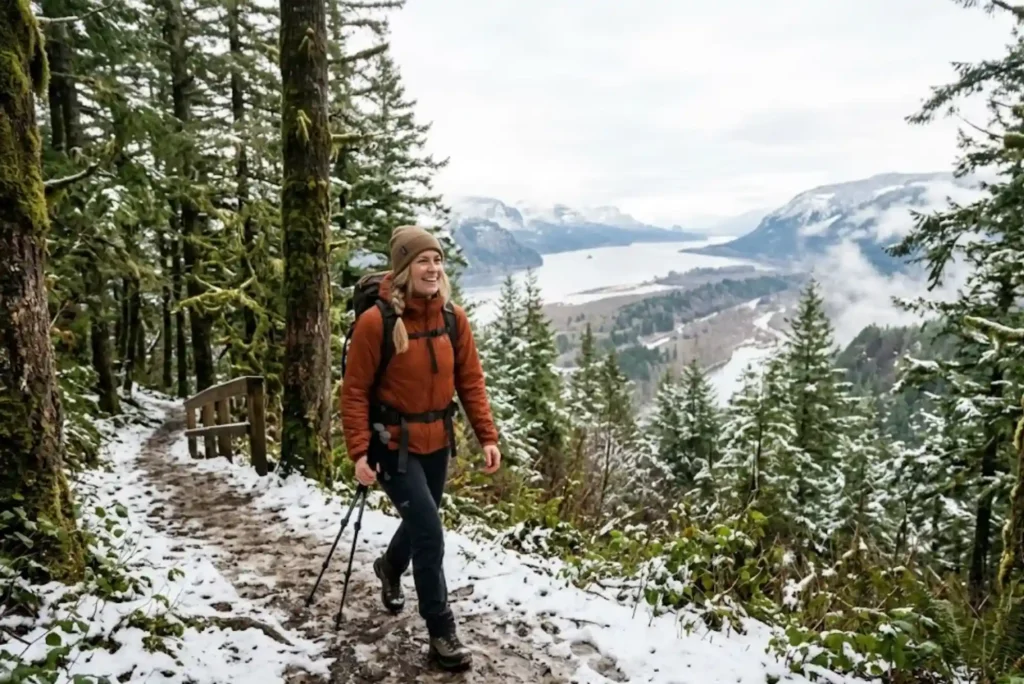
Why Portland Is One of the Best Winter Hiking Cities in the Pacific Northwest
Most outdoor enthusiasts think of winter hiking as something reserved for snowshoers in mountain terrain. Portland’s geography makes a compelling argument for a different kind of winter adventure. At elevations below 1,000 feet — where most of Portland’s most accessible trails sit — winter means rain, not snow. That distinction matters enormously. Trails remain walkable year-round, waterfall flows peak in January and February, and the combination of overcast light and lush vegetation creates photographic and atmospheric conditions that simply do not exist in summer.
The temperate climate of the Willamette Valley means temperatures rarely drop below freezing at trail level. Most Portland-area hikes remain ice-free even in the coldest months. What you are managing in winter is moisture — waterproofed footwear, a rain layer, and mud-tolerant expectations — rather than the avalanche awareness and technical gear that mountain winter hiking demands.
For visitors unfamiliar with the regional trail network, the variety is remarkable. Portland’s accessible hiking options span old-growth forest loops, basalt gorge rim trails, riverside paths, and urban green corridors that weave through the city itself. Together, they create a year-round hiking calendar with no genuine off-season.
Forest Park: The Urban Wilderness That Thrives in Winter
Forest Park is one of the largest urban forests in the United States — 5,200 acres of continuous woodland running along the Tualatin Mountains on Portland’s west side. Its proximity to the city and the density of its trail network make it the default winter hiking destination for most Portland residents, and for good reason.
Wildwood Trail
The Wildwood Trail runs for 30.2 miles through Forest Park — the longest urban forest trail in the country. In winter, the entire length is accessible, typically mud-softened but never treacherous. Most hikers approach it in sections; the most rewarding winter segments run between the Hoyt Arboretum and the park’s northern reaches near Newberry Road, where old-growth Douglas fir and western red cedar create a canopy dense enough to provide meaningful shelter from rain even during moderate downpours.


The trail’s gentle grade makes it accessible to hikers of all fitness levels. Expect the forest floor to shift from a summer carpet of ivy and oxalis to a winter palette of deep greens, dark bark, and the russet of fallen maple leaves. Wildlife — deer, red-tailed hawks, and the occasional great horned owl — is more frequently visible in winter when foliage thins.
Leif Erikson Drive
Running parallel to Wildwood for approximately 11 miles, Leif Erikson Drive is an unpaved fire road that offers a wider, flatter alternative for those who prefer firm footing even in wet conditions. It drains better than the narrower trail sections and is particularly good for running or hiking with dogs. Views through the trees to the Willamette Valley and Mount St. Helens appear on clear winter days.
Columbia River Gorge: Where Winter Hiking Reaches Its Peak
The Columbia River Gorge National Scenic Area — stretching east from the Portland metropolitan area along the Washington-Oregon border — is arguably the finest winter hiking destination in the entire Pacific Northwest. Its waterfalls, which number over seventy along the Oregon side alone, reach their maximum flow between November and March. Hiking the Gorge in winter means experiencing these falls at their most dramatic: roaring, mist-generating, and frequently double their summer volume.
| Trail | Distance | Elevation Gain | Winter Highlights | Difficulty |
|---|---|---|---|---|
| Latourell Falls Loop | 2.4 miles | 400 ft | Oregon’s highest single-drop waterfall at peak flow | Easy |
| Multnomah Falls via Larch Mountain | 2.4 miles (base trail) | 700 ft (to viewpoint) | America’s most visited waterfall in dramatic winter light | Moderate |
| Angel’s Rest | 4.8 miles | 1,500 ft | Panoramic Gorge views; low-elevation summit accessible year-round | Moderate |
| Horsetail Falls Loop | 2.7 miles | 500 ft | Multiple waterfalls including the walk-behind Ponytail Falls | Easy–Moderate |
| Beacon Rock | 1.8 miles | 650 ft | Washington side; dramatic Gorge views from ancient volcanic plug | Moderate |
Latourell Falls: The Best Easy Winter Hike in the Gorge
At 224 feet, Latourell Falls is the tallest single-drop waterfall in the Columbia River Gorge. The 2.4-mile loop that circles the falls and its upper sister cascade is perfectly suited to winter hiking — the trail is well-maintained, the waterfall viewpoints are protected enough to observe without total drenching, and the columnar basalt formations that frame the falls are at their most dramatic under grey winter skies. This is the best option for first-time Gorge hikers or those with limited time but maximum visual payoff.
Angel’s Rest: Winter’s Best Viewpoint Hike
Angel’s Rest is one of the Gorge’s most rewarding summit hikes for the effort involved. The 1,500-foot elevation gain over 2.4 miles is steady but never technical, and the rocky summit plateau at the top offers unobstructed views west toward the Portland metro area and east deep into the Gorge. In winter, this viewpoint is frequently above the valley fog layer — a phenomenon unique to the season where Portland sits under a grey blanket while hikers above it enjoy clear winter sun and blue sky. The contrast is extraordinary and worth the climb specifically for the winter experience.
Multnomah Falls in Winter: Managing the Crowds and the Conditions
Multnomah Falls — with its 620-foot two-tier cascade — is the most visited natural attraction in Oregon and sees a dramatic reduction in crowd volume between November and February. Winter is genuinely the best time to experience it. The historic lodge is open year-round, the paved trail to the Benson Bridge is always accessible, and the falls themselves run at their most powerful from December through March.
The trail above the bridge toward the Larch Mountain viewpoint becomes significantly more challenging in winter — steeper sections can become slick with moisture, and the upper trail above the viewpoint enters snow territory after significant storms. For most winter visitors, the bridge and lower viewpoint deliver everything the experience promises without the need for trail spikes or technical preparation.
A Columbia River Gorge Express shuttle service operates seasonally from Gateway Transit Center in Portland, reducing parking pressure and allowing hikers to access multiple Gorge trailheads in a single day without a car. This is the recommended approach for winter visits when road conditions on the Historic Columbia River Highway can occasionally be affected by ice or debris from storm activity.
Tryon Creek State Natural Area: Portland’s Quiet Winter Forest
Tryon Creek State Natural Area sits in southwest Portland — a 658-acre forest preserve threaded by eight miles of hiking trails, three miles of horse trails, and a dedicated nature center that operates year-round. Unlike Forest Park’s dense connectivity and the Gorge’s dramatic topography, Tryon Creek offers a quieter, more contemplative winter hiking experience focused on the forest itself rather than destination viewpoints.
The creek-bottom habitat supports some of the most diverse winter flora in the Portland area. Sword ferns, trillium (which begins emerging in late winter), and the ubiquitous bigleaf maple create a layered visual environment that rewards slow, attentive hiking. The trail surfaces are primarily soft soil that drains reasonably well, though waterproofed footwear is still recommended for anything beyond the main gravel paths.
Tryon Creek is particularly well-suited to families with young children and to hikers who find the Gorge’s steeper terrain less accessible. The flat to gently rolling topography of the main trail loops makes it one of the most genuinely year-round accessible hiking areas in the metro region.
Powell Butte Nature Park: Winter Prairie Views Above Portland
Powell Butte is an extinct shield volcano rising 630 feet above southeast Portland, covered in a mix of orchard remnants, native meadow, and second-growth forest. Its summit meadow delivers some of the clearest panoramic views of the Cascade Range available from any publicly accessible point within the city — and those views are often at their best in winter, when atmospheric clarity after storm systems produces crystal visibility of Mount Hood, Mount Adams, Mount St. Helens, and Mount Rainier simultaneously.
The summit ridge is exposed and can be windswept in winter storms — a windproof outer layer is essential for summit visits during front passage. The forested trail approach from the main trailhead is sheltered and comfortable in all but the most severe weather. The combination of protected forest approach and exposed summit panorama makes Powell Butte a winter hike with two distinct character experiences in under five miles of total distance.
Silver Falls State Park: Oregon’s Crown Jewel Winter Trail
Silver Falls State Park sits approximately one hour south of Portland near Silverton, Oregon — a slightly longer drive but a winter hiking experience that rewards the journey completely. The Trail of Ten Falls loops 7.2 miles through ancient forest, passing behind and beneath ten separate waterfalls with a combined vertical drop approaching 1,400 feet. In winter, every one of those falls runs at maximum volume.
| Waterfall | Height | Walk-Behind Access? | Winter Accessibility |
|---|---|---|---|
| South Falls | 177 ft | Yes | Year-round; most dramatic in winter |
| Lower South Falls | 93 ft | Yes | Year-round |
| North Falls | 136 ft | Yes | Year-round |
| Upper North Falls | 65 ft | No | Year-round |
| Twin Falls | 31 ft (each) | No | Year-round; combined winter flow impressive |
The walk-behind falls — South Falls, Lower South Falls, and North Falls — are accessible year-round and represent the defining experience of the park. Standing behind a 177-foot waterfall in February, with the entire weight of a winter rainstorm channeled into a single plunging column of water and mist, is one of the genuinely irreplaceable outdoor experiences available in the Pacific Northwest.
Cape Horn Trail (Washington Side): The Gorge’s Best All-Season Loop
The Cape Horn Trail on the Washington side of the Columbia River Gorge offers a perspective on the Columbia that most Oregon-side hikers never discover. The 7.2-mile loop climbs from the river to the top of dramatic basalt cliffs before descending through mixed forest back to the trailhead. Winter conditions on the lower trail sections are mild; the upper cliff traverse offers exposed views that are genuinely spectacular after frontal systems clear and the river below reflects winter light.
The Washington side of the Gorge also avoids the crowd concentration that the Oregon side’s Historic Highway route attracts, even in reduced winter volumes. Cape Horn frequently offers genuine solitude in January and February — an increasingly rare experience on any trail within an hour of a major metropolitan area.
Essential Winter Hiking Gear for Portland Trails
Portland’s winter hiking conditions are forgiving compared to alpine environments, but they do require specific preparation. The primary challenges are moisture management and traction — not cold temperature or altitude.
- Waterproof hiking boots: This is non-negotiable for any Portland winter trail. Gore-Tex or equivalent membrane boots keep feet dry across muddy trails, creek crossings, and sustained rain without the weight penalty of mountaineering boots.
- Waterproof rain jacket with hood: A breathable waterproof shell — not a fleece, not a softshell — is essential. Look for fully taped seams and an adjustable hood that works with a pack’s shoulder straps.
- Waterproof pants or rain pants: Often skipped and frequently regretted on heavily vegetated trails where brush contact transfers moisture more efficiently than direct rain.
- Moisture-wicking base layer: Cotton holds moisture against skin and causes rapid chilling when you stop moving. Merino wool or synthetic base layers keep you comfortable through variable exertion levels.
- Trekking poles: More valuable on winter trails than in summer. Muddy descents, log crossings over swollen creeks, and the general instability of saturated soil all benefit significantly from poles.
- Microspikes (for Gorge rim trails): Not always needed, but essential to carry for trails above 1,000 feet when temperatures drop below freezing after storms. Latourell and Angel’s Rest are occasionally icy at higher sections after cold fronts.
Trail Conditions and Closures: What to Check Before You Go
Portland’s winter weather can close or significantly degrade trails with little advance notice. Storm damage — fallen trees, washed-out bridges, trail slides — is a seasonal reality in the Gorge particularly, where the combination of steep terrain and high precipitation creates regular erosion events.
The Columbia River Gorge National Scenic Area suffered extensive fire damage in the 2017 Eagle Creek Fire that closed large sections of the Gorge trail system for several years. As of 2026, most trails have reopened, but checking current conditions before any Gorge hike remains essential — the US Forest Service Trail Conditions page and the Friends of the Columbia Gorge website both maintain current trail status information.
For Forest Park specifically, the Portland Parks and Recreation Bureau publishes trail conditions and closure notices on its website and through its social media channels. Tryon Creek State Natural Area closures are managed by Oregon State Parks. Checking these sources the morning of any winter hike takes two minutes and can save significant frustration from arriving at a closed trailhead or an impassable trail section.
Winter Hiking Difficulty Comparison: Portland’s Top Trails at a Glance
| Trail | Location | Distance | Winter Difficulty | Best For | Drive from Portland |
|---|---|---|---|---|---|
| Wildwood Trail (section) | Forest Park | 2–10 miles (variable) | Easy | Beginners, dogs, urban access | 0–15 min |
| Latourell Falls Loop | Columbia Gorge | 2.4 miles | Easy | Families, first-time Gorge hikers | 30 min |
| Angel’s Rest | Columbia Gorge | 4.8 miles | Moderate | Fit hikers wanting panoramic views | 35 min |
| Horsetail Falls Loop | Columbia Gorge | 2.7 miles | Easy–Moderate | Waterfall enthusiasts, half-day trips | 35 min |
| Tryon Creek loops | SW Portland | 1–5 miles | Easy | Families, quiet forest, year-round access | 15 min |
| Powell Butte summit | SE Portland | 3–5 miles | Easy–Moderate | Cascade panorama views, varied terrain | 20 min |
| Cape Horn Loop | WA Gorge | 7.2 miles | Moderate | Experienced hikers, solitude seekers | 45 min |
| Trail of Ten Falls | Silver Falls SP | 7.2 miles | Moderate | Waterfall lovers, full-day adventure | 60 min |
Safety Tips for Winter Hiking Around Portland
Pacific Northwest winter hiking carries a specific risk profile that differs from desert or alpine winter environments. The primary hazards are hypothermia from sustained moisture exposure, slippery trail surfaces, swollen creek crossings, and the disorientation that overcast conditions can cause on less-marked trail systems.
- Tell someone your plans: Even on well-traveled trails like those in Forest Park, winter conditions can change rapidly. Leave your trail name, trailhead location, and expected return time with a contact who knows to act if you do not check in.
- Never cross flooded creek crossings: After heavy rain, normally minor creek crossings can become dangerous. If a crossing looks questionable, turn back — the waterfall downstream is not worth the risk.
- Carry a headlamp: December and January daylight in Portland runs from approximately 8 AM to 4:30 PM. Trails that seem like afternoon hikes can turn into evening navigation problems faster than expected.
- Check weather forecasts specifically: General Portland weather forecasts often underestimate conditions in the Gorge, where the temperature differential between the valley and the rim can produce ice and snow even when the city is rain-only.
The Best Month-by-Month Winter Hiking Calendar for Portland
Understanding how conditions shift month by month helps with targeted trip planning. Portland’s “winter hiking season” spans roughly November through March, but each month has its own character.
| Month | Trail Conditions | Waterfall Flow | Recommended Trails |
|---|---|---|---|
| November | Wet, leaf litter, moderate mud | Building toward peak | Forest Park, Tryon Creek, Latourell |
| December | Heavy rain, deep mud on some trails | High flow begins | Latourell Falls, Wildwood, Powell Butte |
| January | Peak rain; possible Gorge ice above 1,000 ft | Peak flow — best waterfall month | Gorge lower trails, Silver Falls, Forest Park |
| February | Similar to January; trillium emerging late month | Near-peak flow | All Gorge trails, Silver Falls, Tryon Creek |
| March | Rain easing; mud persists; wildflowers beginning | Strong but easing | Angel’s Rest, Cape Horn, Silver Falls |
January is the month that Portland’s waterfall trails genuinely peak. The combination of maximum precipitation, full watershed saturation, and the muscular light of a Pacific storm system makes Gorge hikes in January the most visually spectacular of any season. If you can only hike one month in winter, make it January.
Planning Multi-Trail Winter Days: Combining Portland Hikes
One of Portland’s great winter hiking advantages is the density of trails accessible in a single day. A well-planned winter hike day might combine a morning loop at Latourell Falls (2.4 miles, fully absorbs in 90 minutes), a lunch stop at the Multnomah Falls Lodge, and an afternoon exploration of the Horsetail Falls Loop — three distinct waterfall experiences spanning less than five miles of total hiking and about ten miles of driving.
The Columbia River Gorge Express shuttle facilitates this kind of multi-stop day perfectly — you board at Gateway Transit Center, access the Gorge’s Historic Highway trailheads without parking stress, and return to Portland in the early evening. For those who prefer driving themselves, the Historic Highway trailhead parking lots are manageable in winter at weekday levels and occasionally strained on clear winter weekends when the first good weather of the season brings everyone outdoors simultaneously.
For comprehensive trail discovery beyond the well-known Gorge locations — including trails that reward locals who know where to look — exploring curated hikes in Portland that cover the broader metro region expands your options considerably beyond the trails everyone already knows.
Winter Photography on Portland Trails: What Makes These Hikes Visually Exceptional
Winter is genuinely the best season for photography on Portland-area trails, and understanding why helps set expectations for first-time winter hikers who arrive expecting the lush green of summer brochure photography and instead find something quieter and, to many eyes, considerably more beautiful.
The diffused, even light of overcast winter days eliminates the harsh shadows that challenge outdoor photography in summer. Waterfalls photograph best under cloudy skies — the even illumination reveals the fall’s full structure and movement without blown-out highlights. Forest trails take on a depth and saturated color under grey winter light that summer’s high-contrast sunshine actually diminishes. Mist and fog create natural depth separation between foreground and background elements — a quality that landscape photographers deliberately seek.
Gorge viewpoints like Angel’s Rest and Cape Horn are particularly rewarding on the clear days that follow frontal passage. The combination of washed air, low winter sun angle, and snow-capped Cascade peaks visible to the east produces the kind of images that appear in national park promotional materials. These conditions are rare in summer and fairly common — if unpredictable — in winter.
Frequently Asked Questions: Winter Hiking in Portland
Are Portland hiking trails open in winter?
Yes. The vast majority of Portland-area hiking trails remain open throughout winter. Forest Park, Tryon Creek, and Powell Butte are accessible year-round. Columbia River Gorge trails occasionally experience temporary closures after storm damage or ice events — check the US Forest Service website for current status before any Gorge hike.
Do I need snowshoes to hike near Portland in winter?
For trails below 1,500 feet — which includes all the trails listed in this guide — snowshoes are not needed. Snow at this elevation is rare and melts quickly after storms. Microspikes are useful for icy conditions on Gorge rim trails after cold fronts, but even those are situational rather than standard equipment for most winter Portland hikes.
What is the best easy winter hike near Portland for beginners?
The Latourell Falls Loop (2.4 miles, 400 feet of elevation gain) is the best combination of accessibility and visual reward for first-time or beginner winter hikers. The trail is well-maintained, the waterfall is genuinely spectacular in winter flow, and the difficulty is manageable for almost any fitness level with appropriate footwear.
When is the best time to see waterfalls at peak flow near Portland?
January and February are the peak waterfall months in the Columbia River Gorge and at Silver Falls State Park. These months combine the highest cumulative precipitation with fully saturated watersheds, producing the maximum flow volumes that make falls like Latourell, South Falls, and Multnomah most dramatic. Early morning visits on weekdays offer both the best light and the fewest crowds.
Is Forest Park safe to hike alone in winter?
Forest Park is generally safe for solo hiking in winter daytime hours. The park’s proximity to the city and the volume of regular users — even in winter — means you are rarely genuinely remote. Standard precautions apply: tell someone your plans, carry a charged phone, bring a headlamp for early darkness, and stay on marked trails. The park’s western edge borders residential areas throughout its length.
Final Thoughts: Embrace Portland’s Winter Trails
The hikers who discover Portland’s winter trail culture rarely go back to waiting for summer. The rain, the mist, the swollen waterfalls, the forest deepened by moisture and absence of crowds — these are not obstacles to great hiking. They are precisely what makes winter hikes in Portland some of the most rewarding in the entire Pacific Northwest. Equip yourself appropriately, check conditions before you go, and approach the season with curiosity rather than resignation. The trails will deliver experiences that fair-weather hiking simply cannot.
From the urban solitude of Forest Park’s Wildwood Trail to the roaring magnificence of Silver Falls in January, Portland’s winter hiking calendar is genuinely extraordinary. Start with the easier options — Latourell Falls, Tryon Creek, Powell Butte — and work your way toward the more ambitious loops as your confidence and kit develop. The Pacific Northwest rewards the curious and the prepared in equal measure. For a broader look at the full range of trail options available across the region and beyond, hikes in Portland and surrounding areas offer a continuously updated resource for outdoor explorers at every level. Pull on your rain jacket, lace up your waterproofed boots, and go find out what most people are missing.
